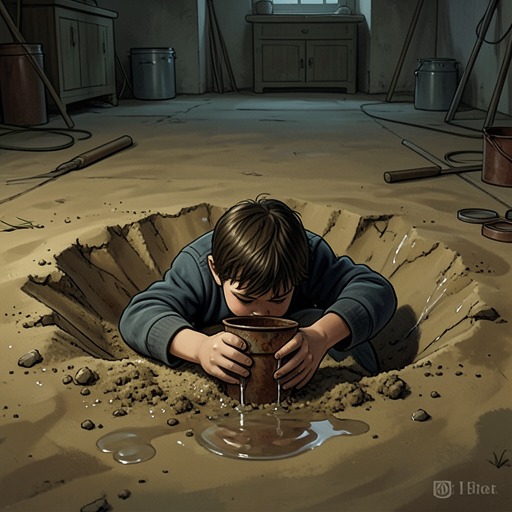
Chemari Goñi’s Drowning in the Swimming Pool
Los renglones torcidos de DiosChemari Goñi’s drowning at the Club Loreto swimming pool became, for Ignacio Urquieta, a death whose meaning surfaced only thirty years later. As a child, Ignacio heard that Chemari had drowned with his roller skates on and pushed away a terrible doubt about what had happened. Much later, the shock of being thrown into water as an adult made the childhood encounter return with a new and devastating implication: Ignacio came to believe that he had caused his schoolmate’s death.
The Childhood Encounter and Its Cover Story
The episode belongs to Ignacio’s childhood, when he was five and known as Iñaqui. After an encounter with Chemari, Iñaqui ran home crying, wearing his raincoat and only his socks. He told his mother that, with time to spare before the early tram, he had gone to the harbor, approached children fishing below a small landing, slipped on moss, and fallen into the water. The account is explicitly presented as a lie, not as a reliable explanation of what had happened. Its details nevertheless establish that a childhood episode involving water preceded the later news of Chemari’s death.
The next day, Iñaqui walked to school to avoid meeting Chemari on the tram. The precaution proved unnecessary: Chemari, his companion in skipping school the day before, was absent too. Neither attended on the day the first-term grades were given, just before the Christmas holidays began. The narrative supplies this sequence of absences but does not establish what Chemari did during those days or how he came to be in the pool.
The Body at Club Loreto
After the holidays, Iñaqui returned to school and learned that Chemari had drowned. Employees discovered his body at the bottom of the Club Loreto pool as they were preparing to empty it. Chemari still had his roller skates on, a striking physical detail that would persist in Ignacio’s later reconstruction of the death.
Iñaqui was horrified by the news, but the narration also says he did not grieve much because he had not liked Chemari. A terrible doubt briefly came to him, then he rejected it. He decided that the likeliest explanation was that Chemari had gone back to the club to skate during the days he was absent from school before the holidays. That conclusion gave the child a way to account for the death without confronting his own possible involvement; the account does not confirm that Chemari had actually returned to skate or settle how he drowned.
The Memory Returns
For thirty years, Ignacio did not think about the episode again. The old memory returned when patients at the asylum threw him, fully dressed, into a swimming pool. The sensation of the incident brought back an earlier bodily experience so forcefully that he felt the present become the past: the pool seemed to be Club Loreto in Bilbao, and the person who had pushed him seemed to be Chemari rather than Bocanegra. The scene connects the childhood death to the adult pool attack through Ignacio’s physical reaction, before his account turns into an explicit explanation.
Remembering Chemari’s body with the skates on, Ignacio joined the image of a drowned figure to the schoolmate he had lost. He wondered whether he had previously been told about the skates and had refused to take the information in. He then identified Chemari Goñi as the dead boy and became certain that he had been the one who killed him. This is Ignacio’s recovered conviction, not an independent confirmation of the mechanics or cause of Chemari’s drowning; uncertainty remains part of the revelation.
Aftermath and Narrative Significance
Ignacio told the doctors what had come back to him, then repeated the account to Alice Gould a few days later over lunch at Pepe el Tuerto’s Roast Grill. A large jug of water stood between them as a silent witness to his recovery. Both had received declarations of health that day and had decided to celebrate together. The setting makes the water that triggered Ignacio’s memory present again, now alongside his effort to tell what he had long forgotten.
The death thus changes significance across time. At first it is news of an absent schoolmate, met with shock, limited grief, and a quickly rejected doubt. Decades later, a repeated encounter with water reorganizes those scattered childhood details into a possible confession. The narrative reveals Ignacio’s certainty about his responsibility while preserving a distinction between that certainty and what can be established about Chemari’s final moments.